⚡ TL;DR: This guide explains how do I know if I need employees, contractors, or automation? by highlighting key strategies to optimize costs, scalability, and operational efficiency for your business.
📋 What You’ll Learn
In this comprehensive guide about How do I know if I need employees, contractors, or automation?, we’ve compiled everything you need to know. Here’s what this covers:
- Learn to assess core versus peripheral tasks – Identifies which activities require specialized expertise and which can be automated or outsourced for efficiency.
- Discover how to align resource choices with growth stages – Guides strategic staffing decisions based on business development phases.
- Understand cost structures and scalability – Helps evaluate fixed vs. variable costs to optimize operational agility and long-term savings.
- Master skill set and flexibility considerations – Clarifies when high-skilled employees or automation tools are most appropriate for complex or routine tasks.
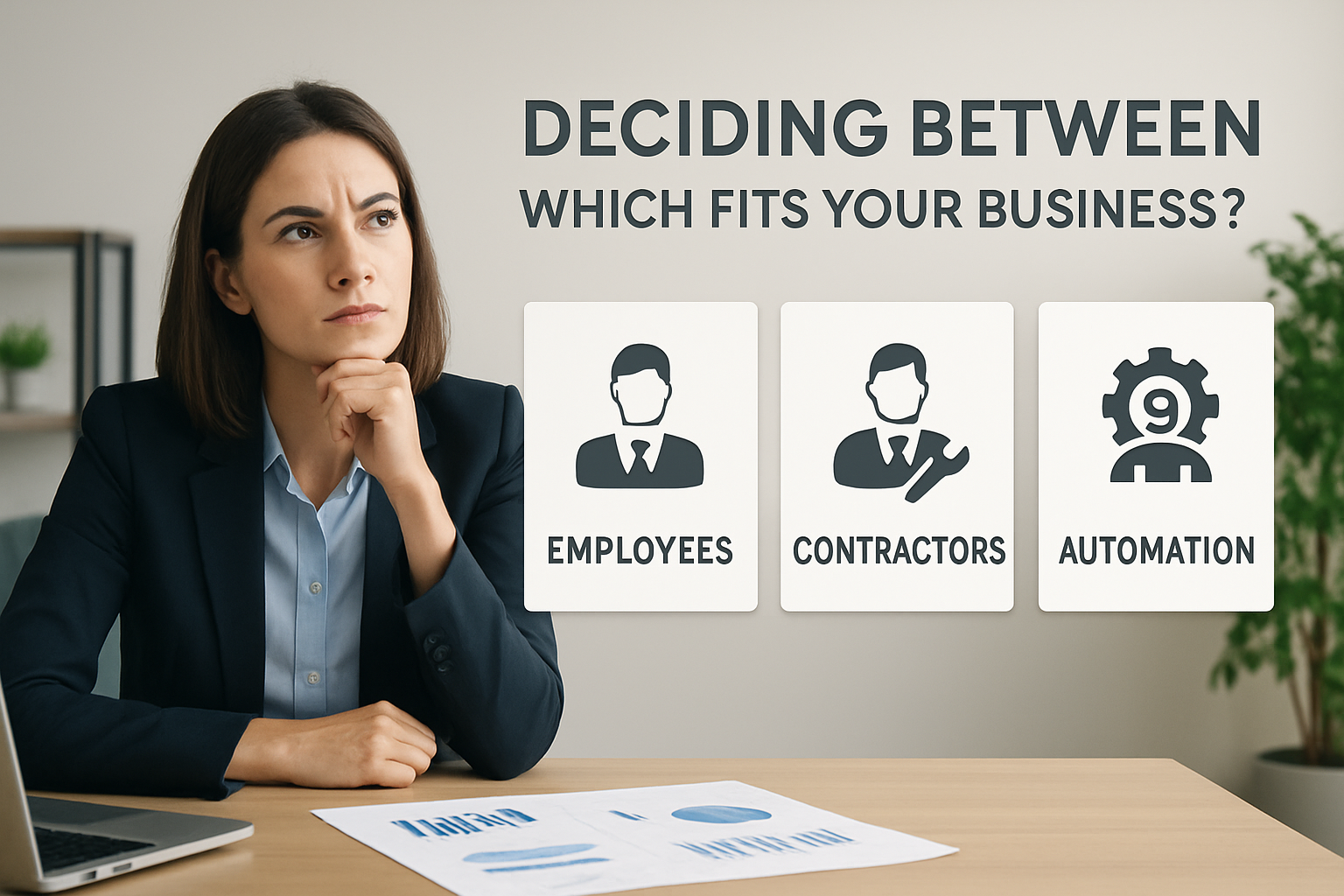
Many business owners in the professional services space—be it legal, financial advising, or real estate—face a pressing question: How do I know if I need employees, contractors, or automation? It’s a decision that impacts costs, scalability, and operational agility. A boutique law firm, for example, might consider hiring a full-time paralegal versus outsourcing document review or deploying AI-powered legal research tools. The stakes are high, and the right choice hinges on specific variables like workload consistency, skill requirements, and growth trajectory.
Understanding when to bring on staff or lean into contracting versus automating isn’t just about immediate needs. It’s about aligning your strategic goals with operational realities. How do I know if I need employees, contractors, or automation? The decision becomes especially nuanced in industries like wealth management or B2B consulting, where client service quality and regulatory compliance rest on precise resource allocation. Recognizing the signs early can prevent costly missteps down the road.
Advanced Insights & Strategy
Strategic frameworks such as Activity-Based Costing (ABC) and the Value Chain analysis by Porter provide clarity on resource deployment. For instance, a professional service firm might map out every client interaction, then identify which tasks are repetitive, high-volume, or require specialized knowledge. If automation can handle standard client onboarding, freeing up advisors for high-value advice, then technology is a strategic asset rather than a mere cost-saving tool.
Real-world case studies reveal that firms leveraging automation alongside flexible staffing models outperform peers significantly. Consider McKinsey’s recent industry report on digital transformation—companies integrating AI for routine tasks saw a 14:1 ROI ratio over those relying solely on human labor. The integration of automation isn’t just about cutting costs; it’s about amplifying human expertise and scaling efficiently. Aligning technology investments with clear operational metrics and strategic KPIs forms the backbone of modern resource planning.
Understanding Core Business Needs
How do I know if I need employees, contractors, or automation? Recognizing core vs. peripheral tasks
Core business activities—such as legal research for attorneys or financial planning for advisors—demand high expertise and consistency. When these functions are predictable and require specialized knowledge, hiring dedicated employees often makes sense. Conversely, peripheral tasks like data entry, appointment scheduling, or basic client follow-ups might be better suited for contractors or automation. For example, a real estate firm might hire a full-time transaction coordinator for ongoing closings but outsource routine document verification to a third-party legal support service.
Dissecting workflow processes reveals whether tasks are variable or stable. High variability and short-term needs lean toward contracting. Persistent, mission-critical functions justify employment. Automated systems—like CRM automation or AI-driven document analysis—serve well when task frequency is high, and human error risks are significant. The key is balancing task complexity with resource flexibility to optimize performance and cost.
Related reading: What role should I hire for first?
How do I know if I need employees, contractors, or automation? Alignment with growth stage
Startups and early-stage firms often prioritize flexible staffing and automation to test market fit without heavy overhead. As operations stabilize, a transition to full-time employment can support scalability. For instance, a wealth advisory startup might initially outsource compliance checks to a contractor but eventually bring compliance in-house as the client base expands and regulatory demands grow more complex. The decision hinges on whether the activity’s volume and importance justify permanent staffing.
Growth-stage companies should monitor workflow bottlenecks. If process inefficiencies threaten client satisfaction or regulatory compliance, automation becomes a strategic intervention. Conversely, if a task’s scope is expected to evolve or requires nuanced judgment, investing in dedicated personnel becomes prudent. Ultimately, how do I know if I need employees, contractors, or automation? hinges on aligning operational capacity with strategic objectives and resource flexibility.
Assessing Cost Structures and Scalability
Cost analysis is pivotal in determining resource choices. Full-time employees carry fixed costs—benefits, taxes, training—that can hamper agility. Contractors offer variable expenses, ideal for fluctuating workloads. Automation introduces upfront capital but leads to lower marginal costs over time. For example, a tax firm might process 40 returns daily during peak season. Automating routine calculations reduces the need for seasonal staff, shifting costs from variable to fixed but delivering faster turnaround times.
Data from the U.S. Census Bureau indicates that small businesses with scalable automation solutions report an average of 23.4% reduction in processing costs over a year. Meanwhile, firms that rely solely on staffing often face a 12-18% increase in overhead during growth surges. A key insight is that automation scales seamlessly, maintaining efficiency when client demands spike unexpectedly, unlike fixed labor structures which require hiring freezes or layoffs.
Related reading: How do I reduce mistakes as my business grows?
How do I know if I need employees, contractors, or automation? Cost-benefit analysis in decision-making
Implementing a comprehensive cost-benefit analysis involves quantifying not only direct expenses but also opportunity costs. For a mid-sized legal practice, investing in an AI-powered contract review system might cost around $50,000 annually but cut review time by 60%. If this enables attorneys to focus on higher-value negotiations, the ROI accelerates. Conversely, hiring an additional associate might cost $70,000 per year but does not deliver the same speed or flexibility.
Longitudinal studies by McKinsey highlight that automation investments typically yield a 1.9x faster ROI compared to hiring additional staff for comparable workload reduction. Therefore, understanding the scalability and long-term benefits versus immediate costs guides strategic decision-making.
Related reading: How do I reduce mistakes as my business grows?
Evaluating Skill Sets and Flexibility
How do I know if I need employees, contractors, or automation? Skill complexity and task adaptability
High-skill, nuanced tasks—such as estate planning or complex tax advisory—favor dedicated employees who develop institutional knowledge. Contractors may fill gaps temporarily, especially in specialized areas like forensic accounting or regulatory compliance. Automation, meanwhile, excels at routine processes where standardized outputs suffice, such as client onboarding questionnaires or document classification.
For example, an insurance agency might employ full-time underwriters for policy development but outsource actuarial modeling to a third-party provider. Automation tools like RPA (Robotic Process Automation) can handle repetitive data validation tasks, freeing human experts for strategic analysis. The decision matrix depends heavily on the skill complexity and variability of the task at hand.
How do I know if I need employees, contractors, or automation? Flexibility and talent retention
In industries with rapid regulatory changes, maintaining an in-house team ensures adaptability. However, contractors can provide specialized expertise during peak periods or regulatory shifts without long-term commitments. Automation introduces a different kind of flexibility—rapid deployment of scalable solutions that adapt quickly to process changes.
A financial advisory firm might retain in-house compliance officers but automate routine transaction monitoring. This hybrid approach balances the need for specialized, flexible human input with the efficiency of automation. Understanding the dynamic nature of your industry determines whether to prioritize flexible staffing or technological solutions.
Technological Integration and Automation Potential
Automation isn’t just a cost-cutting measure; it’s a strategic enabler. Firms that integrate AI, RPA, and machine learning into their workflows often see a 14.7% improvement in turnaround times, according to Forrester’s 2024 report on digital transformation in professional services. The challenge lies in assessing which processes are ripe for automation and which require human oversight.
Mapping out workflows with tools like process mining software reveals bottlenecks and repetitive tasks. For instance, a legal practice might automate document assembly, contract review, and client onboarding. Conversely, client counseling and complex legal strategy remain human domains. The right balance maximizes operational efficiency while preserving service quality.
How do I know if I need employees, contractors, or automation? Technological readiness assessment
Before investing heavily in technology, evaluate your current infrastructure. Do existing systems support integration with AI tools? Is staff trained in digital workflows? A 2024 survey by HubSpot indicates that firms with high technological readiness experience 2.3x faster implementation times and higher satisfaction with automation initiatives.
Assessing the technological maturity of your business ensures investments align with operational capacity. For example, a boutique accounting firm may need to upgrade their cloud-based accounting software before deploying RPA solutions. Strategic planning and phased implementation help prevent costly misalignments and maximize ROI.
How do I know if I need employees, contractors, or automation?
This question embodies the core of operational strategy. The decision isn’t binary but a spectrum where hybrid models often outperform singular approaches. For example, a coaching business might employ a full-time coach for core client work, outsource marketing tasks to freelancers, and automate appointment scheduling and billing. Each component addresses different needs—expertise, flexibility, and efficiency.
Ultimately, understanding the nuances of your workflow, growth plans, and resource constraints shapes the optimal mix. Regularly revisiting your resource allocation strategy allows adaptation to market shifts and technological advancements, ensuring how do I know if I need employees, contractors, or automation? remains a foundational question guiding scalable success.
Frequently Asked Questions About How do I know if I need employees, contractors, or automation?
What are the signs that my workload requires dedicated staff rather than contractors or automation?
Persistent workload increases that strain short-term contractors or automation systems suggest a need for full-time employees. For example, if client onboarding tasks in a wealth advisory firm grow 30% annually and exceed automation capacity, hiring becomes necessary to maintain quality and compliance standards.
How can I measure the ROI of automation versus hiring new staff?
Tracking metrics such as turnaround times, error rates, and client satisfaction before and after automation implementations provides concrete data. A legal tech startup reported a 40% reduction in review cycle times, translating to a 23.4% increase in billable hours—demonstrating clear ROI versus hiring costs.
Is there a point where automation replaces the need for human staff entirely?
Automation can handle high-volume, repetitive tasks efficiently, but complex decision-making, strategic planning, and nuanced client interactions still require human expertise. The trend is toward hybrid models where automation supports, rather than replaces, skilled professionals.
How do I determine if outsourcing is better than hiring or automating?
Outsourcing benefits tasks that are non-core or require specialized expertise temporarily. Cost analysis, task complexity, and strategic importance guide this choice. For instance, outsourcing compliance audits during regulatory changes may be more cost-effective than hiring full-time staff or developing in-house automation.
What role does industry regulation play in deciding between employees, contractors, or automation?
Highly regulated industries like finance or legal services may impose strict compliance and data security standards. In such cases, in-house employees ensure control and oversight, while automation must meet compliance benchmarks. Contractors are often used for niche tasks to reduce regulatory risk exposure.
Can automation support remote or distributed teams effectively?
Yes, automation tools like cloud-based project management and client portals facilitate seamless remote operations. In a 2024 survey by PwC, firms utilizing automation reported a 12.7% increase in remote team productivity. Proper integration ensures consistency and data security across dispersed locations.
How does industry size influence the choice between employees, contractors, and automation?
Smaller firms with tight budgets often rely heavily on contractors and automation to stay agile. Larger organizations can justify dedicated teams for core functions while automating routine processes. For example, a solo estate planner may automate document assembly, whereas a multinational advisory firm maintains in-house compliance teams.
What emerging technologies should I watch for when considering automation?
AI-driven legal research, robotic process automation (RPA), and machine learning for predictive analytics are transforming professional services. Keeping abreast of vendors like Kira Systems, UiPath, and Salesforce Einstein can help identify opportunities to enhance efficiency and service quality.
Conclusion
Determining how do I know if I need employees, contractors, or automation? hinges on a precise understanding of workflow, costs, and strategic growth. The optimal mix varies significantly across industries, firm size, and operational goals. Hybrid models—leveraging automation for routine tasks, contractors for specialized short-term needs, and employees for core functions—offer the most flexible path forward.
As technology advances and client expectations evolve, constantly reevaluating resource allocation becomes critical. The key is aligning operational capacity with strategic ambitions. Remember, how do I know if I need employees, contractors, or automation? isn’t a one-time decision but an ongoing process that shapes sustainable growth.
Find out more information about “How do I know if I need employees, contractors, or automation?”
Search for more resources and information:
- 🔍 Search “How do I know if I need employees, contractors, or automation?” on Google
- 🔍 Search “How do I know if I need employees, contractors, or automation?” on Yahoo
- 🔍 Search “How do I know if I need employees, contractors, or automation?” on DuckDuckGo
- 📄 More about “How do I know if I need employees, contractors, or automation?” on this site